Montréal
Mon Loup AlphaMontréal is both the setting of Julien’s attempted reinvention and the pressure chamber that transforms his loneliness into attachment, risk, and commitment. Newly arrived from Orlando, Julien experiences the city first as an unfamiliar and isolating place, but its streets and institutions gradually become the ground on which he meets Nemrod, encounters the supernatural struggle surrounding him, and chooses a new form of belonging.
Arrival and Social Dislocation
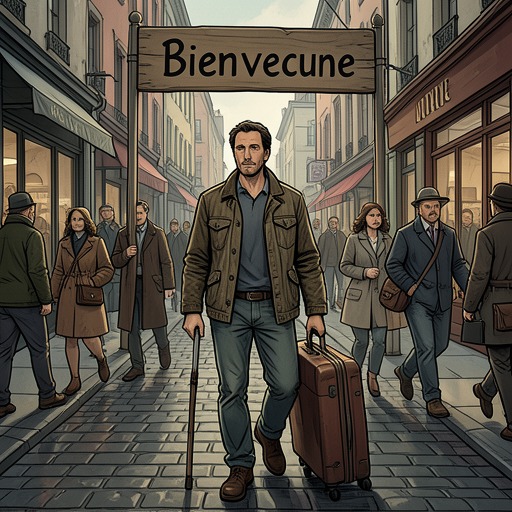
Julien moves from Orlando, Florida, to Montréal to break the routine of his impoverished life as a nurse and begin again in Canada. The relocation gives him the promise of a clean start, yet it also removes him from familiar surroundings and leaves him without an established support network. After only one week in the city, loneliness drives him to a gay dating website, where he meets Tyler, an English-literature student at Université Concordia. Their online conversations seem candid and promising, and Julien asks Tyler to show him around a city that is larger and more complicated than it initially appears.
The city’s linguistic environment intensifies Julien’s sense of estrangement. French is its official language, but Julien speaks it poorly, having completed only two semesters of intermediate French at university. The language barrier is not incidental background: it makes the new city harder to read and contributes directly to the physical and emotional pain he feels while alone there. Montréal therefore represents renewal and exclusion at the same time, offering a new beginning whose social conditions make connection difficult.
Streets, Dating, and the Search for Affection
Julien’s first encounter with Montréal unfolds in Rosemont-La Petite Patrie, where he and Tyler spend an afternoon talking and laughing in severe cold. Julien takes Tyler’s arm, but Tyler does not respond, and Julien immediately interprets the lack of reaction as evidence that he is not truly interested. Although Tyler had planned to remain until five o’clock, he leaves at two, claiming that he must work at a Thai restaurant and collect new uniforms while covering for a sick colleague. The city excursion thus becomes an early lesson in the uncertainty of urban encounters: a planned introduction to Montréal ends in another perceived rejection.
Julien later revisits the city’s gay districts while trying to understand what kind of affection Montréal can offer. On his first night, he takes the métro to Beaudry station and passes the Apollon, Unity, and Sky Complex. He does not enter because he does not want a party; he wants tenderness and a boyfriend, and he doubts that a decent relationship can begin in a gay bar. He does wander into Campus, a gay strip club, where a dancer offers a three-minute lap dance for twenty dollars. Julien declines and leaves, reinforcing the contrast between commercialized sexual attention and the emotional intimacy he seeks.
The urban dating market also sharpens Julien’s resentment and despair. He recalls that the men who approach him online are generally those who attract him least, while the men he wants remain unavailable or silent. His disappointment with Tyler is especially painful because their text exchanges had suggested that both men were direct and meant what they said. Tyler’s failure to send a message explicitly stating his lack of interest leaves Julien suspended between rejection and uncertainty. Montréal’s social spaces consequently become a map of desire that repeatedly promises contact while delivering distance.
Winter City and the Rooftop Crisis
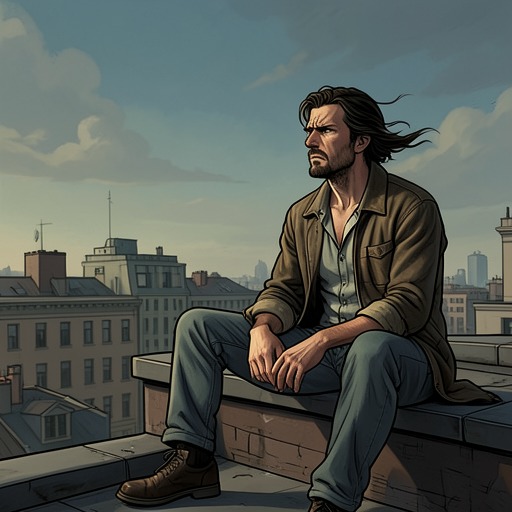
The city’s winter weather gives Julien’s emotional crisis a physical form. He stares at Montréal’s glittering lights as one of the season’s first snowfalls begins, the cold flakes sliding across his reddened face while an icy, furious wind strikes his cheeks. Against this urban panorama, his suffering rises from an abstract sense of failure into bodily pain. His thoughts of suicide are connected to the accumulation of romantic refusals, a pattern he says had already troubled him repeatedly in Orlando and has continued during his brief time in Montréal.
The skyline also creates a visual tension between isolation and possibility. Julien looks outward at a city full of lights, yet feels locked outside its social life by loneliness, language, and repeated disappointment. Montréal is not portrayed simply as hostile; it is full of routes, neighborhoods, clubs, and potential encounters. What makes it painful is the gap between that abundance and Julien’s inability to find the intimate connection he wants. The city’s scale magnifies both his freedom to start over and the emptiness of having no one with whom to share that freedom.
Nemrod and the Hidden City
Montréal becomes a site of supernatural conflict when Julien’s relationship with Nemrod draws him into a world concealed beneath ordinary urban life. Nemrod is pursued by Tyler, revealed as a jaguar, and tells Julien that a fallen attacker was one of Tyler’s henchmen. Nemrod is fighting to become leader of a united pack of werewolves and jaguar-garous, and he apologizes for involving Julien in the political conflict because Montréal has become dangerous for him. The city’s familiar geography is thereby reinterpreted as contested territory, where romantic attachment and clan struggle occupy the same physical space.
The danger reaches Julien’s room when a yellow jaguar appears at his window. Nemrod answers the animal’s roar with a ferocious howl, and the two creatures hold their ground before Nemrod leaps through the window and shatters it. The confrontation turns a private Montréal dwelling into a border between rival animal powers. Julien watches Nemrod fight as an alpha male, feeling both fear for his companion and excitement at seeing him defend Julien’s honor and safety. Animal cries, scent, territorial possession, and bodily combat become the vocabulary through which the city’s hidden political order announces itself.
Yet Montréal also provides the setting for intimacy rather than only threat. Nemrod unexpectedly approaches Julien, wraps both arms around his back, and draws him close. Later, Nemrod smells Julien, an act Julien understands as a way of possessing him, and Julien smells Nemrod in return. Within the city that had initially made Julien feel anonymous, these gestures establish recognition through touch and scent. The urban outsider is no longer merely searching for someone to choose him; he is being claimed within a new relational and supernatural order.
Hospital, Decision, and Meaning
The hospital overlooking Montréal’s winter landscape becomes the place where Julien converts attachment into a decision. Nemrod’s injuries and the surrounding conflict bring the consequences of the city’s hidden struggle into a medical institution, linking Julien’s work as a nurse with his personal involvement. From the hospital window, he sees the winter sunlight declining over Montréal and looks down on a beautiful park where children laugh and couples walk arm in arm.
That view gives the city a final moral contrast. Earlier, Montréal’s lights and snow had accompanied suicidal despair; now the same winter city contains an image of ordinary affection and mutual support. Watching lovers hold hands, Julien decides that love means supporting the person one loves unconditionally. Because he has accepted himself as Nemrod’s companion, Nemrod’s battles have become his own. Montréal thus changes from the place where Julien feels abandoned into the place where he chooses participation, responsibility, and belonging—even though that belonging carries danger.